Quick answer
Leftover beef stew lasts 3 to 4 days in the refrigerator and keeps its best quality for 2 to 3 months in the freezer. Refrigerate it within 2 hours of cooking, divided into shallow containers so it cools quickly. Reheat it to a rolling boil, or at least 165°F, before eating, and throw out stew that sat on the stove or counter overnight.
How long does beef stew last? Less time than many cooks expect, and the clock depends mostly on how fast the pot cooled. The figures below come from USDA leftovers guidance and the federal food storage chart, and they apply to homemade beef stew with or without wine, potatoes or other vegetables.
Stew deserves more care than most leftovers because of its size. A big pot of meat and gravy holds heat for hours, and that slow cooling is exactly when certain bacteria thrive. The refrigerator limit concerns safety rather than flavor, so stew that still smells fine on day five is not necessarily safe.
Below, you will find a storage chart, how to cool a large pot safely, and why stew left out overnight belongs in the trash. After that come freezing, thawing, reheating and the signs that stew has spoiled.
Beef Stew Storage Times at a Glance
| Beef stew | How long | Notes |
|---|---|---|
| In the refrigerator (40°F or below) | 3 to 4 days | Count from the day you cooked it |
| In the freezer (0°F) | 2 to 3 months for best quality | Safe beyond that, but the texture declines |
| At room temperature | 2 hours at most | 1 hour when the air is above 90°F |
| Kept hot for serving | As long as it stays at 140°F or above | Check with a thermometer |
These times follow the cold storage chart, which lists soups and stews at 3 to 4 days in the refrigerator and 2 to 3 months in the freezer. The chart also notes that freezer times describe quality rather than safety, because food kept frozen at 0°F stays safe indefinitely.
Start counting on the day you cooked the stew, not the day you refrigerated it. So if you made it on Sunday, finish or freeze the leftovers by Wednesday or Thursday. Reheating it does not restart the count.
Why Big Pots of Stew Need Special Care
Stew carries a particular risk that most leftovers do not. The bacterium Clostridium perfringens forms hardy spores that can survive cooking. According to the North Dakota health department, beef, poultry and gravies are common sources. Then the spores germinate and multiply while food cools or sits between 40°F and 140°F.
A deep pot of stew can spend hours in that range if it cools on the stove or goes into the refrigerator whole. Likewise, the CDC prevention guidance links outbreaks to foods cooked in large batches and then held at unsafe temperatures. Symptoms, mainly cramps and diarrhea, usually begin 6 to 24 hours after eating. Fortunately, the fix is simple: cool the stew quickly and keep it cold.
How to Cool and Store Beef Stew
The goal is to move the stew from hot to cold as fast as possible. These steps follow the USDA and CDC advice:
- Refrigerate within 2 hours: serve the meal, then put leftovers away before the 2-hour mark, or within 1 hour on a hot day.
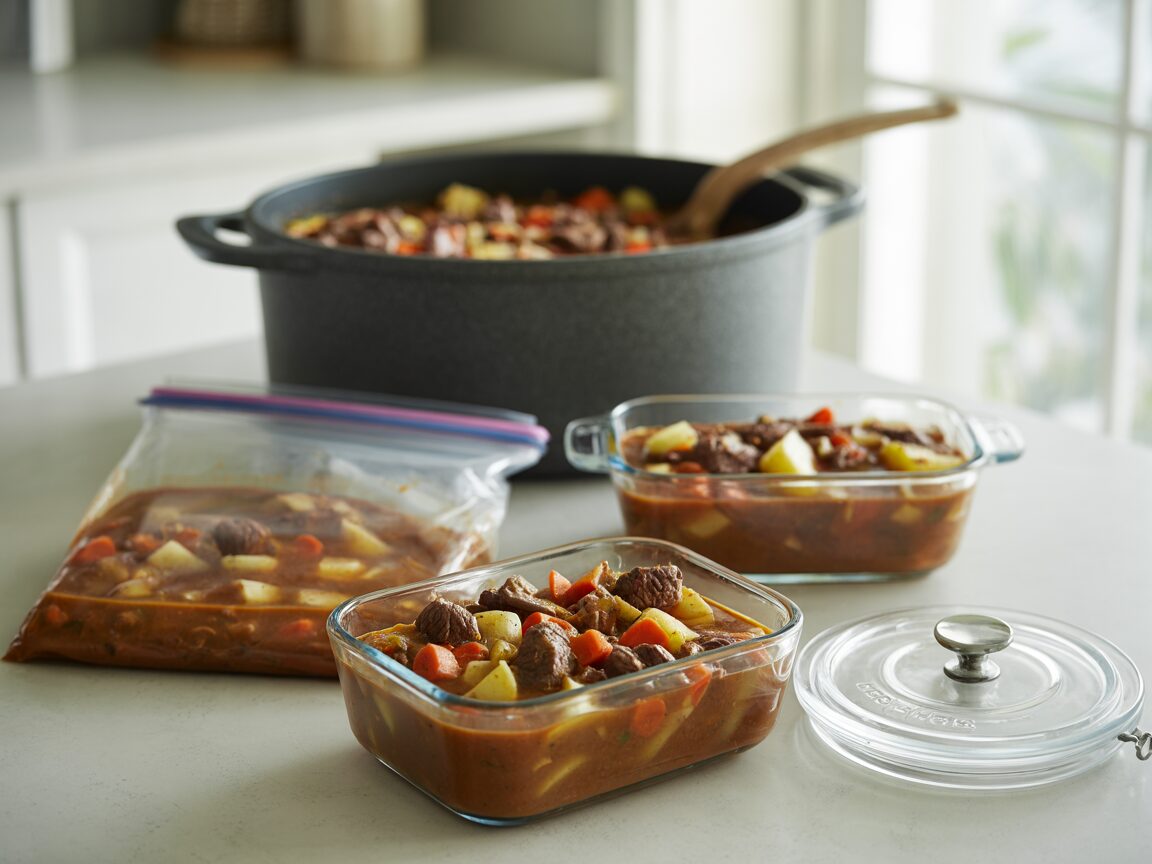
- Divide the pot: ladle the stew into several shallow containers, no more than a few inches deep, rather than chilling the whole pot.
- Speed it up if needed: for a very large batch, set the containers in a sink of ice water for 15 to 20 minutes, stirring occasionally.
- Cover and label: seal the containers once the stew has stopped steaming, and write the cooking date on each one.
There is no need to let stew cool on the counter first. A refrigerator handles warm food safely, especially when it arrives in small, shallow portions with space around them for air to circulate.
Can You Leave Beef Stew Out Overnight?
No. Stew that sat on the stove or counter overnight has spent many hours in the temperature danger zone, so discard it. Reheating it to a boil the next morning does not undo those hours, so the CDC advice to refrigerate within 2 hours applies even to stew you plan to reheat.
Similarly, the same rule covers stew left in a switched-off slow cooker, or one whose “keep warm” setting stopped during a power cut. If you cannot be sure it stayed at 140°F or above, throw it out.
How to Freeze Beef Stew
Beef stew freezes well, which makes it ideal for cooking in big batches. The beef and gravy hold up beautifully, whereas potatoes tend to turn grainy and soft once frozen and thawed.
- Cool first: chill the stew in the refrigerator before freezing it.
- Consider the potatoes: for the best texture, freeze stew without potatoes and add freshly boiled ones when you reheat it.
- Portion it: use freezer containers or heavy freezer bags in meal-size amounts, leaving about an inch of space for expansion.
- Label and date: use the stew within 2 to 3 months for the best quality.
Freezer bags laid flat on a baking sheet freeze quickly and then stack neatly, saving valuable freezer space. Once solid, they also thaw considerably faster than deep containers, which makes a weeknight dinner from the freezer far more practical.
How to Thaw Frozen Beef Stew
The USDA lists three safe ways to thaw leftovers. The refrigerator is the easiest, usually taking overnight to a full day, and you should eat stew thawed this way within a day or two. For faster results, submerge a sealed bag in cold water, changing the water as it warms, or use the defrost setting on a microwave, then reheat the stew right away.
You can also skip thawing. Run the container under warm water to loosen the block, then heat it in a covered pot over low heat, stirring as it softens. Never thaw stew on the counter, since the outside warms into the danger zone long before the center thaws.
How to Reheat Beef Stew
The USDA advises reheating sauces, soups and gravies to a rolling boil, and the CDC recommends heating leftovers to 165°F or hotter. For stew, the stovetop does both easily.
| Method | How | Tip |
|---|---|---|
| Stovetop | Covered over medium heat, stirring often, until it reaches a rolling boil | Add a splash of broth to loosen thick gravy |
| Microwave | Covered, on medium power, stirring every minute or two | Check several spots, since microwaves heat unevenly |
| Oven | Covered at 350°F until bubbling throughout | Best for a large batch in its original pot |
Reheat only as much as you plan to eat. Every round of cooling and reheating softens the vegetables and dries the beef, so smaller portions taste better.
Reheating Stew for a Party in a Slow Cooker
A slow cooker heats too gently to bring cold leftovers through the danger zone quickly. The USDA slow cooker guidance says to reheat leftovers to 165°F on the stove, in a microwave or in an oven first. Then transfer the hot stew to a preheated slow cooker and hold it at 140°F or warmer while you serve.
Can You Refreeze Beef Stew?
Yes, with one condition. According to the USDA, you can safely refreeze any leftovers that remain after reheating previously frozen stew to 165°F. The texture suffers with each round, however, so freeze stew in single-meal portions in the first place.
How to Tell If Beef Stew Has Gone Bad
Throw stew out once it passes 4 days in the refrigerator, even if it seems fine. Before that point, these signs also mean it belongs in the trash:
- A sour, off or unusually sharp smell
- Fuzzy mold on the surface or the sides of the container
- A slimy film on the beef or vegetables
- Bubbling or fizzing when you stir it cold
However, the bacteria that cause food poisoning rarely change how stew looks, smells or tastes. That is why the time limit matters more than these signs, and why you should discard stew of unknown age.
Stews With Other Meats, Canned Stew and Takeout
The same storage times apply well beyond beef. The cold storage chart groups all soups and stews together, regardless of the main ingredient. As a result, chicken, lamb, pork and vegetable stews also last 3 to 4 days in the refrigerator and 2 to 3 months in the freezer, exactly like beef. Stews thickened with cream or cheese follow the same limits, although they tend to separate after freezing.
Canned beef stew is different until you open it. Unopened, shelf-stable cans keep in the pantry until the date printed on the can. Once opened or heated, however, canned stew becomes an ordinary leftover, so transfer it to a covered container, refrigerate it, and finish it within 3 to 4 days.
For takeout or restaurant stew, start the clock when you pick it up, since you rarely know when the kitchen made it. Therefore, refrigerate it within 2 hours of collecting it, and aim to eat it sooner rather than later.
Tips to Keep Leftover Stew Tasting Fresh
- Skim the fat: once chilled, the fat hardens on top, so lift it off before reheating for a cleaner gravy.
- Store the gravy with the meat: beef left uncovered by liquid dries out and absorbs refrigerator odors.
- Refresh the seasoning: after reheating, taste and add a pinch of salt, pepper or fresh herbs, because chilling dulls flavors.
- Add fresh vegetables: a handful of peas or freshly cooked potatoes brightens a stew that has been frozen.
Frequently Asked Questions
Is beef stew good after 5 days in the fridge?
It is safest not to eat it, because the USDA limit for leftover stew is 3 to 4 days, after which you should freeze or discard it.
Can you freeze beef stew with potatoes?
Yes, and it is safe, but the potatoes often turn grainy. For the best texture, freeze the stew without them and add fresh potatoes when reheating.
How long can beef stew stay in a slow cooker on warm?
As long as it stays at 140°F or hotter, it remains safe to serve. Check it with a thermometer every hour or so, and refrigerate leftovers within 2 hours once the cooker is switched off.
Is it safe to eat cold leftover beef stew?
Reheating is the safer choice, because the USDA and CDC both recommend bringing leftovers to 165°F before serving. Cold stew straight from the refrigerator also tastes greasy, since the fat has set.
Does wine in beef stew make it last longer?
No. Most of the alcohol cooks off, so wine does not preserve the stew. The same 3 to 4 day limit applies.
Can you put a hot pot of stew straight in the fridge?
Yes, but divide it into shallow containers first. A full, deep pot cools too slowly and can warm the food around it.
Bringing It Together
Leftover beef stew lasts 3 to 4 days in the refrigerator and 2 to 3 months in the freezer for the best quality. Cool it quickly in shallow containers within 2 hours, and freeze it without potatoes for the best texture. Finally, reheat it to a rolling boil or 165°F, and throw out any stew left out overnight. To cook the next batch, see the classic beef stew recipe, and for other leftovers, see how long curry lasts.
Key takeaways
- Beef stew lasts 3 to 4 days in the refrigerator.
- Freeze it for 2 to 3 months, ideally without the potatoes.
- Divide large pots into shallow containers and refrigerate within 2 hours.
- Reheat to a rolling boil or 165°F, and never eat stew left out overnight.
- Reheat on the stove before holding stew in a slow cooker at 140°F.
About this guide: storage times follow USDA and FoodSafety.gov guidance, and the cooling and reheating advice follows the USDA, the CDC and the North Dakota health department.