Quick answer
At 450°F, a 2-pound meatloaf shaped on a baking sheet takes about 40 to 50 minutes. The same loaf in a loaf pan takes about 50 to 60 minutes. It is done when the center reads 160°F, or 165°F for turkey or chicken. Add any sugary glaze only in the last 10 minutes so it does not burn.
Knowing how long to bake meatloaf at 450 starts with one idea. The oven temperature sets how fast the outside cooks, but the thickness of the loaf sets how long the center takes. Heat moves through ground meat at a steady pace, so a hotter oven shortens the bake less than you might expect, and it browns the surface much faster.
That trade explains why 450°F works best for loaves that are thin, small or shaped on a sheet. It also explains why high heat needs a little more attention than the usual 350°F. The reward is a deeply browned crust and dinner on the table 20 to 25 minutes sooner.
Below you will find bake times at 450°F by size and pan, plus a chart for every temperature from 325°F to 450°F. After that come the steps that keep a hot oven from scorching the glaze, and how to confirm doneness with a thermometer. The times are typical ranges for a loaf about 2 inches tall, so treat them as a schedule for checking rather than a promise.
Meatloaf Baking Times at 450°F
Shape and size matter more than the recipe itself, since a free-form loaf on a sheet exposes more surface to the heat. It therefore cooks faster than the same meat packed into a deep pan.
| Meatloaf at 450°F | Typical bake time | Start checking at |
|---|---|---|
| Mini loaves, about 9 ounces each | 22 to 28 minutes | 20 minutes |
| Muffin-tin meatloaves, about 3 ounces each | 15 to 20 minutes | 14 minutes |
| 1½ pounds, shaped on a sheet | 35 to 40 minutes | 30 minutes |
| 2 pounds, shaped on a sheet | 40 to 50 minutes | 35 minutes |
| 2 pounds, in a 9 by 5-inch loaf pan | 50 to 60 minutes | 45 minutes |
| 3 pounds, shaped on a sheet | 55 to 65 minutes | 50 minutes |
These ranges assume the meat starts cold from the refrigerator and the loaf stands about 2 inches tall. A taller loaf needs more time, while a flatter one needs less, even at the same weight.
Why 450°F Changes the Result
At 450°F the outer layer of the loaf passes the safe temperature long before the center does. By the time the middle reaches 160°F, the outside has spent much longer in high heat, so it browns deeply and can dry out if the loaf is thick.
High heat also squeezes moisture out of the meat proteins faster, and it renders fat quickly. On a sheet, that fat runs away and the crust crisps, but in a loaf pan it pools around the sides and can spatter or smoke.
Sugar presents the other limitation. Ketchup and brown sugar glazes begin to scorch at high oven temperatures. As a result, a glaze that survives an hour at 350°F can turn black in 30 minutes at 450°F. Timing the glaze carefully, rather than skipping it entirely, solves the problem.
Meatloaf Time and Temperature Chart
If your oven is already set for something else, use this chart to match the meatloaf to it. The figures are estimates for a 2-pound loaf, so start checking about 10 minutes before the low end.
| Oven temperature | 2 lb on a sheet | 2 lb in a loaf pan | 9-oz mini loaves |
|---|---|---|---|
| 325°F | 75 to 85 minutes | 85 to 100 minutes | 45 to 50 minutes |
| 350°F | 65 to 75 minutes | 75 to 90 minutes | 40 to 45 minutes |
| 375°F | 55 to 65 minutes | 65 to 80 minutes | 32 to 38 minutes |
| 400°F | 50 to 60 minutes | 60 to 70 minutes | 28 to 33 minutes |
| 425°F | 45 to 55 minutes | 55 to 65 minutes | 25 to 30 minutes |
| 450°F | 40 to 50 minutes | 50 to 60 minutes | 22 to 28 minutes |
Notice that raising the oven by 100 degrees saves only about 25 minutes. For a thick loaf, 350°F to 375°F gives the most even result, while 425°F to 450°F suits small, flat or sheet-pan loaves best.
How to Bake Meatloaf at 450°F Without Burning It
A few adjustments let you use high heat without a scorched top or a raw middle, provided you follow these steps in order.
- Use a rimmed baking sheet: line it with foil or parchment so fat drains away from the loaf instead of frying the bottom.
- Shape the loaf no taller than 2 inches: a lower, longer loaf lets the center catch up with the outside.
- Put the rack in the center: the top of the oven runs hotter, so the middle position browns more evenly.
- Hold the glaze: brush on a sugary glaze only in the last 10 minutes, or the sugar will burn.
- Tent if needed: if the top is browning too fast, lay a loose sheet of foil over it and keep baking.
- Check early: begin taking the temperature about 10 minutes before the low end of the time range.
- Rest 10 minutes: resting lets the juices settle so the slices hold together.
The classic meatloaf recipe on this site bakes at 350°F, but its sheet-pan shape adapts well to 450°F with the timing above.
Sheet-Pan Meatloaf at 450°F
The fastest way to use a hot oven is to skip the loaf shape entirely. Press a 2-pound mixture into an even layer about 1 inch thick on a rimmed sheet, roughly 9 by 13 inches. Then bake it at 450°F for 20 to 25 minutes.
Because every part of the meat sits close to the surface, a flat sheet-pan meatloaf cooks evenly and browns well across the top. Brush the glaze over it for the last 5 minutes, then rest it for 5 minutes and cut it into squares. The result has more crust per bite than a classic loaf, which many families prefer.
The Two-Stage Method
For a thick loaf, or one baked in a pan, a two-stage bake gives you the browned crust of a hot oven without drying the edges. Start the loaf at 450°F for 15 minutes to set and brown the surface. Then lower the oven to 350°F and continue until the center reaches 160°F.
A 2-pound loaf usually needs about 40 to 50 minutes more after the temperature drops, for a total close to an hour. Brush on the glaze after you lower the heat, since sugar holds up well at 350°F. If you want it glossy and set, add a second thin coat for the final 5 minutes.
This approach suits busy weeknights, because you do not need to watch the loaf closely during the second stage. It also forgives an oven that runs a little hotter than its setting.
Convection Ovens and Air Fryers
A convection fan moves hot air across the meat, so it browns and cooks faster than a standard oven. If you use convection at 450°F, lower the setting to 425°F and begin checking about 10 minutes earlier than the times above.
Air fryers behave like small, very powerful convection ovens. Mini loaves of about 9 ounces usually take 18 to 22 minutes at 375°F. That lower setting matters, because 450°F in an air fryer would char the outside quickly. Whatever the appliance, the same 160°F and 165°F targets apply.
How to Tell When Meatloaf Is Done
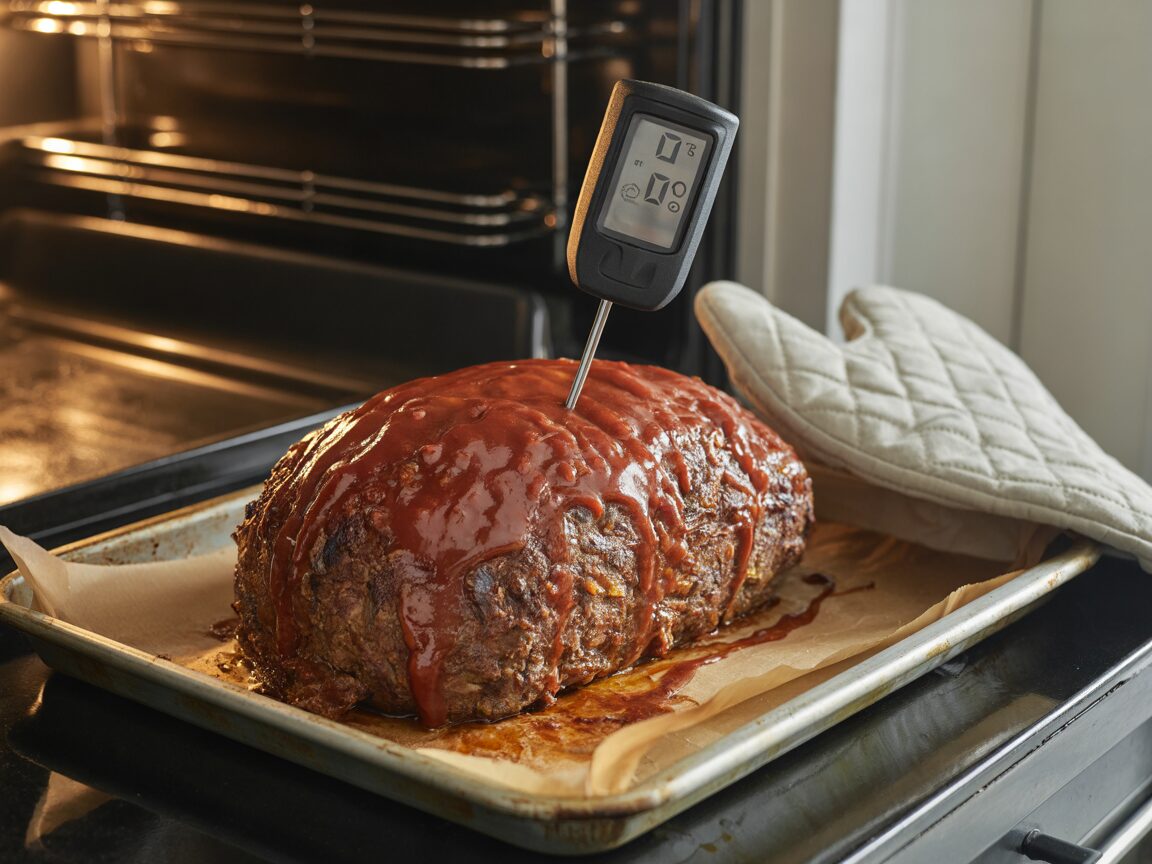
An instant-read thermometer is the only reliable test at any oven temperature. According to the FoodSafety.gov chart, meatloaf made with ground beef or pork is safe at 160°F, while one made with ground turkey or chicken needs 165°F.
Where you measure matters as much as the number, and the FSIS thermometer guidance says to place the probe in the thickest part of the food. For meatloaf, push it in from the side until the tip sits in the very center. Check a second spot near the ends of a long loaf as well.
Do not rely on color as an indicator, because USDA research found that ground beef can turn brown before it reaches a safe temperature. In addition, the FSIS color guidance notes that properly cooked meat can still look pink. High heat makes this trap worse, because a dark crust can hide an underdone center.
Take the loaf out once it reads 160°F rather than earlier. The temperature keeps rising a few degrees while it rests, which helps the texture, but the center should already be at the safe mark when it leaves the oven.
Does the Meat Mix Change the Time?
The cut of meat changes the texture more than the clock. A loaf made with 85/15 beef, a beef and pork blend, or classic meatloaf mix bakes in about the same time. Thickness, not fat content, controls how quickly heat reaches the center.
Leaner meat is less forgiving at high heat, however. With 90/10 or 93/7 beef, the margin between done and dry shrinks considerably. Start checking at the low end of the range, and remove the loaf the moment it reaches 160°F. Mix-ins such as cheese, bacon or vegetables add moisture and bulk, which can stretch the time by 5 to 10 minutes.
Is Your Oven Really at 450°F?
Home ovens frequently run 15 to 25 degrees away from the number on the dial, and that difference matters more at high heat. An inexpensive oven thermometer, placed on the center rack, shows the actual temperature and explains why a recipe’s timing may not match your results.
Preheating thoroughly is equally important, since many ovens signal that they are ready before the walls have fully absorbed the heat, so allow an extra 10 minutes after the signal. Dark, heavy baking sheets also absorb more heat than light aluminum ones, which can darken the underside of the loaf, so lining the sheet with parchment provides a helpful buffer.
Turkey and Chicken Meatloaf at 450°F
Poultry meatloaf bakes in about the same time as beef of the same size, but it needs to reach the higher 165°F. Because ground turkey and chicken are leaner, they dry out faster at 450°F. Add 2 to 3 tablespoons of extra milk to the panade and keep the loaf on the low, wide side.
The two-stage method works especially well for poultry, so start at 450°F for 15 minutes, then finish at 350°F. That sequence gives the browned crust without the dry edges that lean meat develops in a very hot oven.
Baking Frozen Meatloaf
A raw meatloaf can go into the oven straight from the freezer, but 450°F is the wrong temperature for it. The outside would burn long before the frozen center thawed and cooked through.
Instead, bake a frozen 2-pound loaf at 350°F and expect it to take roughly half again as long as a thawed one, often close to 2 hours. Add the glaze once the center has thawed, and confirm the final temperature with a thermometer. Better still, thaw the loaf overnight in the refrigerator and bake it as usual.
Mini Meatloaves and Meatloaf Muffins
Small portions are where 450°F really shines, because the heat only has to travel a short distance. Consequently, the outside browns at the same pace the center cooks, and dinner is ready in under half an hour.
Shape 9-ounce mini loaves on a lined sheet, or pack about 3 ounces of mixture into each cup of a greased muffin tin. Bake minis for 22 to 28 minutes and muffin cups for 15 to 20 minutes, adding the glaze for the last 5 minutes in both cases.
Sides That Bake Alongside at 450°F
A hot oven is an opportunity to cook the entire dinner at once. Vegetables roast beautifully at 450°F, so place a second sheet on the rack below and time each one to finish with the meatloaf.
| Side dish | Preparation | Time at 450°F |
|---|---|---|
| Potatoes | 1-inch chunks tossed with oil and salt | 35 to 45 minutes |
| Carrots | Halved lengthwise, tossed with oil | 25 to 30 minutes |
| Green beans | Trimmed, tossed with oil and garlic | 12 to 15 minutes |
| Broccoli | Florets tossed with oil | 15 to 20 minutes |
Troubleshooting High-Heat Meatloaf
Most problems at 450°F trace back to a loaf that is too thick or a glaze added too early, so match the symptom below to its corresponding fix.
| Problem | Likely cause | Fix |
|---|---|---|
| Burnt glaze | Glaze added at the start | Brush it on for the last 10 minutes only |
| Dark outside, underdone center | Loaf too tall or packed in a pan | Shape it lower on a sheet, or use the two-stage method |
| Dry, crumbly edges | Lean meat or too long in high heat | Use 85/15 beef, add milk, and start checking earlier |
| Smoke from the oven | Fat pooling and burning | Bake on a rimmed sheet, or pour off fat halfway |
| Cracked top | Surface set too fast | Lower the rack to the center and tent with foil |
Frequently Asked Questions
Is 450°F too hot for meatloaf?
Not for small or flat loaves, which bake evenly and brown well at 450°F. For a thick loaf or one in a pan, a lower temperature or the two-stage method gives a juicier result.
Should meatloaf be covered at 450°F?
Leave it uncovered so the crust browns, but lay foil loosely over the top if it darkens before the center is done. Covering it the whole time steams the loaf instead of browning it.
How long does a 1-pound meatloaf take at 450°F?
A 1-pound loaf shaped on a sheet usually takes about 25 to 35 minutes. Begin checking at 20 minutes and take it out when the center reads 160°F.
How long should meatloaf rest after baking at 450°F?
Rest it for about 10 minutes on the pan before slicing. The juices settle during that time, so the slices hold together instead of crumbling onto the board.
Can you bake meatloaf at 450°F with potatoes on the same pan?
Yes. Toss 1-inch potato chunks in oil and spread them around the loaf, since they roast in roughly the same 40 to 50 minutes. Turn them once halfway so they brown evenly.
Does a glass baking dish change the time?
Yes, glass heats slowly and then holds heat, so the sides can overbrown at 450°F while the center lags. Many cooks lower the oven by 25°F when baking in glass and check with a thermometer.
Bringing It Together
Baking meatloaf at 450°F is a sound choice when you shape the loaf for it. Shaped on a sheet and no taller than 2 inches, a 2-pound loaf usually finishes in 40 to 50 minutes. That saves about 25 minutes over 350°F and gives a deeper crust.
The hotter the oven, the more the loaf’s shape matters. Mini loaves and muffin cups thrive at 450°F, while thick loaves and loaf pans do better with the two-stage method or a gentler 350°F to 375°F. In every case, hold a sugary glaze until the last 10 minutes so it caramelizes instead of burning.
Above all, let a thermometer make the call. Beef and pork meatloaf is ready at 160°F and poultry at 165°F, measured in the thickest part of the loaf. Neither the clock nor the color of the crust can confirm what is happening in the center.
Key takeaways
- At 450°F, bake a 2-pound loaf on a sheet for about 40 to 50 minutes, or 50 to 60 minutes in a loaf pan.
- Shape the loaf no taller than 2 inches so the center keeps pace with the outside.
- Add sugary glaze only in the last 10 minutes to stop it from burning.
- Take it out at 160°F for beef or pork and 165°F for turkey or chicken.
How this guide was built: its bake times are estimated ranges for a loaf about 2 inches tall, scaled from standard 350°F timings. Doneness temperatures and thermometer placement follow FoodSafety.gov and USDA guidance.