Quick answer
If you forget the baking soda, banana bread still bakes, but it rises very little. The loaf comes out dense, flat-topped and paler than usual, with a tighter, sometimes gummy crumb and a slightly flatter, less salty taste. It is still safe to eat once the center bakes through. Next time, use the soda, or replace 1 teaspoon of it with 1 tablespoon of baking powder.
What happens if you forget baking soda in banana bread? Nothing dangerous, and it is one of the most common baking slips. The bread simply loses most of its lift, because baking soda is the only thing in a typical recipe that makes the batter rise.
Below, you will find exactly how the loaf changes, what to do depending on when you notice, and the best swaps if you are out of baking soda. After that come ways to use a dense loaf, what happens with too much soda, and how to check that your box still works.
What Baking Soda Does in Banana Bread
Baking soda is sodium bicarbonate, an alkaline powder that needs an acid to work. According to NDSU Extension, baking soda requires an acidic ingredient to produce carbon dioxide, the gas that inflates the batter. In banana bread, that acid comes mainly from brown sugar and the ripe bananas themselves.
As soon as the wet and dry ingredients meet, the soda and acid start releasing bubbles. Then, in the oven, those bubbles expand with the heat and set into the soft, open crumb you expect. Baking soda also raises the alkalinity of the batter, which encourages browning. That is why a loaf made with soda has a deep golden crust and a darker interior.
Baking soda is also powerful in small amounts. NDSU Extension notes that it has about four times the leavening power of baking powder, so a single teaspoon does most of the lifting for an entire loaf.
How the Loaf Changes Without It
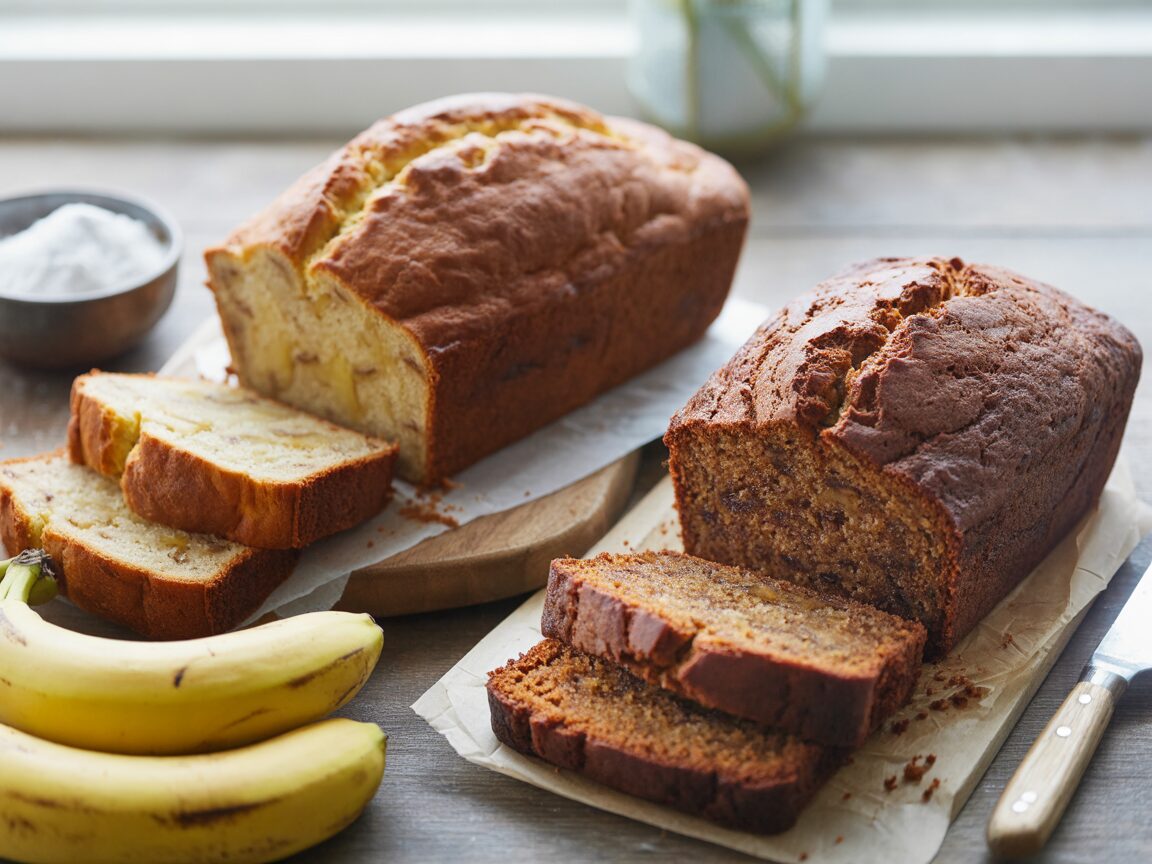
Without baking soda, the batter has almost nothing producing gas, so the loaf barely rises. Here is what to expect compared with a normal loaf:
| Quality | With baking soda | Without baking soda |
|---|---|---|
| Height | Domed top, often with a crack | Flat or slightly sunken top |
| Crumb | Soft, open and tender | Dense, tight and heavy, sometimes gummy in the center |
| Color | Deep golden brown | Pale tan inside and out |
| Flavor | Rich, rounded and lightly salty | Slightly flatter and tangier, since the acids are not neutralized |
| Baking time | About 55 to 65 minutes | Often longer, because the dense center takes more time to set |
The loaf is not ruined, though. Many people describe it as closer to a moist banana cake or a fudgy banana brick, and it can still taste good, especially toasted.
Is It Still Safe to Eat?
Yes. Baking soda affects texture, not safety, so a loaf without it is perfectly safe once the center has finished baking. The one thing to watch is the center. A dense loaf holds more moisture in the middle, so check it carefully with a toothpick or skewer, which should come out clean or with a few moist crumbs.
If the middle is still wet, return it to the oven and tent the top with foil to stop it from overbrowning. Raw batter is worth avoiding, since the FDA flour guidance warns that raw flour can carry Salmonella and E. coli.
What to Do Depending on When You Notice
| When you notice | What to do |
|---|---|
| Before the flour goes in | Add the baking soda with the dry ingredients as usual; nothing is lost |
| Batter mixed, still in the bowl or pan | Sprinkle the soda evenly over the batter and fold it in gently with a spatula, about 10 to 15 strokes, then bake right away |
| Loaf already in the oven | Let it finish baking; stirring now would deflate it and leave raw streaks |
| Loaf already baked | Check the center is done, then enjoy it as a denser loaf or use it in the ideas below |
When folding soda into finished batter, break up any lumps first by pressing it through a small sieve. Otherwise, pockets of undissolved soda can leave bitter, yellow-green specks in the crumb.
Best Substitutes if You Are Out of Baking Soda
If you realize before you start that the box is empty, these options give the best results:
- Baking powder: the University of Illinois Extension advises tripling the amount, so use 1 tablespoon of baking powder for each teaspoon of baking soda. The loaf rises well but comes out paler and slightly less tender, because baking powder carries its own acid.
- Self-rising flour: it already contains baking powder and salt, so swap it for the all-purpose flour and leave out the baking soda and salt.
- Whipped egg whites: separate the eggs, beat the whites to soft peaks, and fold them in last. This adds lift without chemical leaveners, although the loaf is still denser than usual.
Baking powder is the most reliable choice, and many cooks already have it for fluffy pancakes. Whichever swap you use, bake until a toothpick in the center comes out clean.
How Baking Soda Affects the Salt in Each Slice
Baking soda is pure sodium bicarbonate, so it contributes more sodium than most cooks realize. According to USDA FoodData Central values, 1 teaspoon of baking soda carries about 1,260 milligrams of sodium. Spread across a 10-slice loaf, that is roughly 125 milligrams per slice.
| Leavening in the loaf | Sodium from the leavening | Per slice (10 slices) |
|---|---|---|
| 1 teaspoon baking soda | About 1,260 mg | About 125 mg |
| 1 tablespoon double-acting baking powder | About 1,460 mg | About 145 mg |
| No leavening | 0 mg | 0 mg |
So forgetting the soda removes about 125 milligrams of sodium from each slice, which is one reason the loaf can taste flatter. In the moist banana bread recipe, that roughly halves the sodium, from about 260 to about 135 milligrams per slice. Meanwhile, the baking powder swap adds slightly more sodium than the soda it replaces.
Ways to Use a Dense Banana Loaf
A heavy loaf makes an excellent ingredient, because its firm texture holds up where a fluffy loaf would fall apart:
- Banana bread French toast: dip thick slices in beaten egg and milk, then cook in butter until golden.
- Bread pudding: cube the loaf, soak it in custard, and bake until set and puffed.
- Toasted slices: toast or pan-fry slices in butter, then top with peanut butter, honey or yogurt.
- Trifle or parfait: layer cubes with whipped cream or yogurt and sliced fruit.
- Crumble topping: dry thin slices in a low oven, crush them, and scatter over ice cream or oatmeal.
What Happens With Too Much Baking Soda
Adding too much is a bigger problem than leaving it out. NDSU Extension warns that excess baking soda can lead to heavy or fallen cakes and a bitter or soapy taste. Similarly, the University of Illinois Extension notes that too much soda without enough acid can give baked goods a metallic flavor.
Signs of too much soda include a very dark, reddish-brown crumb, a soapy aftertaste, and a loaf that rose quickly and then sank. Unfortunately, nothing fixes it after baking, so measure with a level teaspoon rather than a heaping one.
How to Check Your Baking Soda Still Works
Baking soda loses strength slowly once the box is open, so a weak box can produce a flat loaf even when you remember it. To test it, stir ¼ teaspoon into 2 tablespoons of vinegar or lemon juice. If it fizzes vigorously right away, it is still active. If it barely bubbles, replace it.
Store baking soda in a tightly closed container in a cool, dry cupboard, away from the stove and sink, since moisture and odors weaken it over time. It also helps to write the opening date on the box. That way, you can test it before an important bake instead of discovering a weak box when the loaf comes out flat.
Keep a box of baking powder on hand as well. It covers you when the soda runs out, and it is the backup that rescues the most banana bread, muffin and pancake recipes on short notice.
Why Banana Bread Uses Baking Soda, Not Baking Powder
Most banana bread recipes call for baking soda alone because the batter already contains plenty of acid. Brown sugar carries molasses, and very ripe bananas add mild acidity of their own. Baking soda reacts with that acid, so the batter rises without needing any extra acidic ingredient.
Using soda this way also neutralizes some of that acidity. As a result, the loaf tastes rounder and less tangy, and the slightly alkaline batter browns into the deep color people associate with banana bread. Baking powder, by contrast, brings its own acid, which is why a powder-only loaf tastes a little sharper and bakes up lighter in color.
The Same Mistake in Other Quick Breads
The same rules apply to most quick breads that rely on baking soda, including zucchini bread, pumpkin bread and banana muffins. Without the soda, each one comes out dense, flat and pale, yet remains perfectly safe once baked through. Muffins forgive the mistake best, since their small size lets the center cook fully even without much rise.
Recipes that use both baking soda and baking powder suffer less, because the powder still provides some lift on its own. In those cases, expect a slightly shorter, paler loaf rather than a dense brick.
Frequently Asked Questions
Can you use baking powder instead of baking soda in banana bread?
Yes. Use 1 tablespoon of baking powder for each teaspoon of baking soda. The loaf will rise but come out a little paler and less tender.
Can you add baking soda after the banana bread is baked?
No. Once the crumb has set, nothing can make it rise again. Instead, enjoy the loaf as it is or turn it into French toast or bread pudding.
Will banana bread rise without baking soda?
Only a little. A small amount of steam and air from mixing provides some lift, but the loaf stays dense and flat.
What makes banana bread gummy in the middle?
The usual causes are underbaking, too little leavening or too much banana. Bake until a toothpick in the center comes out clean, tenting the top with foil if it darkens.
Bringing It Together
Forgetting baking soda in banana bread leaves you with a dense, flat, pale loaf, but not a dangerous one. If you notice before baking, fold the soda in gently. If the loaf is already in the oven, let it finish and make sure the center is done. Next time, swap in 1 tablespoon of baking powder if you run out, and test old soda in vinegar before you bake.
Key takeaways
- Without baking soda, banana bread is dense, flat and pale, but safe once fully baked.
- Fold soda into unbaked batter gently if you catch the mistake in time.
- Replace 1 teaspoon of baking soda with 1 tablespoon of baking powder.
- Too much baking soda causes a bitter, soapy or metallic taste.
- Test baking soda in vinegar; it should fizz right away.
About this guide: leavening advice follows NDSU Extension and University of Illinois Extension, sodium figures come from USDA FoodData Central, and the raw batter advice follows the FDA.