Quick answer
How long do deviled eggs last? Covered, they keep 3 to 4 days in the refrigerator at 40°F or below, the same as egg salad. Don’t leave them out more than 2 hours, or more than 1 hour above 90°F. Freezing isn’t recommended, because cooked whites turn rubbery. Whole hard-cooked eggs keep longer, up to 1 week, so fill them close to serving.
Deviled eggs combine two foods that spoil fairly quickly: cooked eggs and a creamy, mayonnaise-based filling. After you peel, halve and fill the eggs, however, the clock runs faster than it does for whole hard-cooked eggs in the shell. As a result, how long deviled eggs last depends mostly on how cold you keep them and how long they sit on the table.
Below, you will find storage times for every stage, from raw eggs to the finished platter. In addition, you will learn the rules for parties and picnics, how to prepare deviled eggs ahead without sacrificing quality, and the signs that it is time to discard them.
How Long Deviled Eggs Last at Each Stage
Standard cold storage charts don’t list deviled eggs by name, so the closest match is egg salad, which has the same ingredients: chopped hard-cooked egg mixed with mayonnaise. The Virginia Department of Health cold storage chart and University of Delaware Extension both list egg salad at 3 to 4 days in the refrigerator. Together with the times for each stage, the picture looks like this:
| Stage | How long it keeps | Freezer |
|---|---|---|
| Raw eggs in the shell, refrigerated | 3 to 5 weeks | Do not freeze in the shell |
| Hard-cooked eggs, whole, refrigerated | 1 week | Do not freeze |
| Deviled eggs, filled, refrigerated | 3 to 4 days | Does not freeze well |
| Deviled eggs at room temperature | No more than 2 hours | — |
| Deviled eggs above 90°F | No more than 1 hour | — |
The refrigerated rows, which assume a refrigerator at 40°F or below, come from the cold storage chart above; the deviled egg row uses its egg salad figure. The time limits on the counter come from the USDA danger zone guidance, and the 1-week figure for whole hard-cooked eggs matches the USDA egg guidance.
Of course, these times assume the eggs went into the refrigerator promptly after cooking. In practice, it helps to count from the day you cooked the eggs, not the day you filled them. For example, eggs cooked on Friday and filled on Saturday still belong in the same short window as eggs filled right away.
Why Deviled Eggs Spoil Faster Than Whole Eggs
At first, a whole hard-cooked egg still in its shell is fairly well protected. Once you peel it, however, you expose its moist surface. According to the USDA, that moisture provides a favorable environment for bacterial growth, including the bacteria that cause spoilage.
Deviled eggs go a step further. Halving the eggs exposes the yolk, mashing it spreads it around, and then spoons and piping bags handle the creamy filling. Every step adds surface area and contact, which is why the finished eggs keep for fewer days than whole ones. Similarly, add-ins such as bacon, fresh herbs or avocado don’t make the eggs last longer, and avocado in particular darkens quickly.
How Long Deviled Eggs Can Sit Out
Meanwhile, the firmest rule applies on the table, not in the refrigerator. According to the USDA, bacteria grow fastest between 40°F and 140°F, and they can double in number in as little as 20 minutes. Therefore, perishable food should not stay out of refrigeration for more than 2 hours, or more than 1 hour when the temperature is above 90°F.
In other words, the 2 hours include every minute out of the refrigerator: carrying the eggs to a party, setting up the table and the time guests spend eating. Once the limit passes, throw out any eggs that are left. Unfortunately, returning them to the refrigerator does not undo the time they spent warm.
Keeping a party platter cold
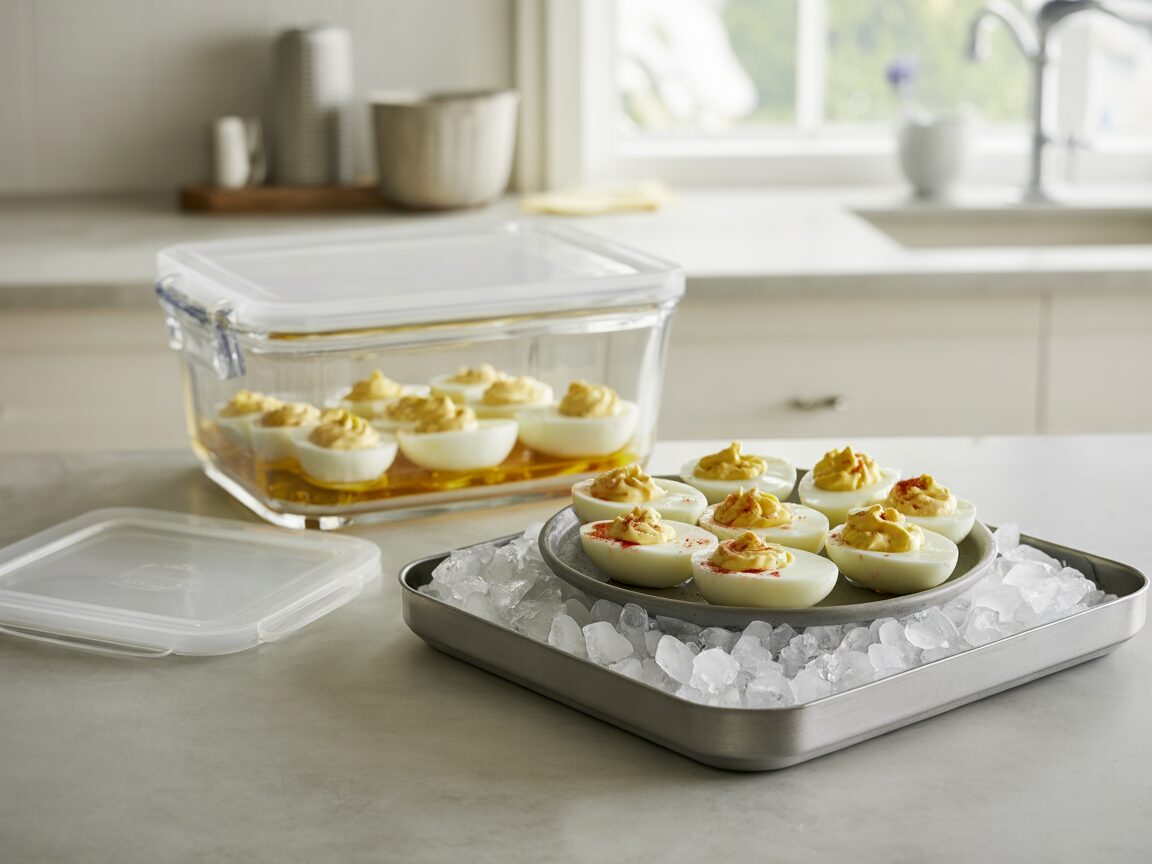
- Serve on ice: the USDA recommends placing cold food in containers on ice. Nest the platter in a larger tray filled with crushed ice.
- Set out small batches: keep half the eggs in the refrigerator and swap in a fresh plate when the first one empties.
- Travel in a cooler: pack the eggs in a covered carrier inside a cooler with ice packs, and keep the cooler in the shade.
- Watch the weather: on a hot day outdoors, the limit drops to 1 hour, so plan to serve and clear the platter quickly.
- Set a timer: note when the platter goes out, so nobody has to guess later.
How to Store Deviled Eggs
Good storage protects both safety and texture, so it deserves a little attention. Follow these steps for leftovers and make-ahead batches alike:
- Chill quickly: refrigerate the eggs as soon as the meal ends, well within the 2-hour window.
- Use a shallow, airtight container: a single layer keeps the filling from getting squashed and lets the eggs chill fast.
- Cover them closely: if you don’t have a lidded container, press plastic wrap gently over the tops or use toothpicks to hold the wrap above the filling.
- Store them in the main compartment: keep the container on a shelf rather than in the door, where the temperature swings each time you open it.
- Label the container: write the date you cooked the eggs, so you know when the 3- to 4-day window ends.
Finally, to keep the refrigerator cold enough, the USDA recommends a setting of 40°F or below. A simple appliance thermometer shows whether yours actually holds that temperature.
Making Deviled Eggs Ahead
Because whole hard-cooked eggs keep longer than filled ones, the smartest plan is to cook ahead and fill late. The USDA says to refrigerate hard-cooked eggs within 2 hours of cooking and use them within a week.
For the best results, therefore, store the components separately. Keep the halved whites in one covered container and the filling in a sealed bag or bowl. Then pipe the filling into the whites shortly before serving, so the tops stay smooth and glossy instead of drying out. Similarly, add paprika, herbs or bacon at the last minute, because toppings lose their color and crunch in the refrigerator. Also, keep the bag of filling sealed tightly, since air dries the surface and dulls the flavor. The classic deviled egg recipe walks through cooking eggs that peel easily and a silky filling that pipes well.
Can You Freeze Deviled Eggs?
Unfortunately, freezing deviled eggs is not a good idea. The USDA advises against freezing hard-cooked eggs, and the cold storage chart says egg salads do not freeze well. In addition, cooked egg whites turn tough, rubbery and watery once thawed, and a mayonnaise filling tends to separate.
Instead, if you have extra yolks or filling, use them within the 3- to 4-day window. For example, leftover filling makes a quick egg salad sandwich, and chopped deviled eggs work well folded into potato salad.
Signs Deviled Eggs Have Gone Bad
Even within the window, throw out deviled eggs if you notice any of the following:
- An off or sulfur-heavy smell: stronger than the usual mild egg aroma.
- A slimy or watery surface: liquid pooling under the whites or a filling that has broken.
- Changes in color: gray, green or dark patches in the filling, or any mold.
- Time: eggs past the 3- to 4-day window, or any that sat out longer than the limits above.
However, appearance and smell are not reliable proof of safety. Bacteria that cause foodborne illness usually don’t change the look, smell or taste of food. So if you are unsure how long the eggs sat out, discard them rather than tasting to check.
What about hidden or dyed eggs?
By contrast, eggs used for an egg hunt are a different case. The USDA egg guidance does not recommend eating hard-cooked eggs after hiding or playing with them. After dyeing, they should go back in the refrigerator within 2 hours. If you plan to make deviled eggs from a holiday batch, cook a separate set for eating.
A Quick Holiday Timeline
For a holiday meal, a simple schedule keeps every stage comfortably inside the recommended windows:
| When | What to do |
|---|---|
| 1 to 2 days before | Cook, cool and peel the eggs; refrigerate whites and yolks separately |
| The morning of | Mix the filling and keep it covered and cold |
| Just before serving | Pipe, garnish and set out half the platter on ice |
| Within 2 hours | Refrigerate or discard what is left on the table |
| Within 3 to 4 days of cooking | Finish the leftovers |
The same planning applies to other dishes on a holiday table. For hot sides and stews, the guide to how long beef stew lasts covers cooling and reheating large batches.
Frequently Asked Questions
Can you eat deviled eggs after 5 days?
It isn’t recommended. Standard cold storage charts list egg salad, the closest match, at 3 to 4 days in the refrigerator.
Can deviled eggs sit out overnight?
No. Discard deviled eggs left out more than 2 hours, or more than 1 hour when it is above 90°F.
How far ahead can you make deviled eggs?
Cook the eggs up to a few days ahead, since whole hard-cooked eggs keep for 1 week. For the best texture, fill them on the day you serve them.
Do deviled eggs need to be refrigerated?
Yes. Keep them at 40°F or below whenever they are not on the table.
Does vinegar or mustard make deviled eggs last longer?
No. The small amount in the filling adds flavor but does not extend the 3- to 4-day window or the 2-hour limit.
Bringing It Together
Deviled eggs keep 3 to 4 days in the refrigerator at 40°F or below, while whole hard-cooked eggs keep for a week. On the table, the limit is 2 hours, or 1 hour in heat above 90°F. Cook the eggs ahead, fill them close to serving, keep the platter on ice, and finally skip the freezer altogether.
Key takeaways
- Filled deviled eggs last 3 to 4 days in the refrigerator.
- Whole hard-cooked eggs last up to 1 week, so fill them close to serving.
- Don’t leave deviled eggs out more than 2 hours, or 1 hour above 90°F.
- Serve the platter on ice and set out small batches.
- Don’t freeze deviled eggs; the whites turn rubbery.
About this guide: refrigerator and freezer times follow the cold storage chart published by the Virginia Department of Health and University of Delaware Extension. Time and temperature limits follow USDA guidance.